
Hello Reader’s who are interested in fitness,
Now that I have addressed the mobility joints of the human body, the elbow joint, and a few myths some people hold and some satisfactory satire it’s time to move onto stability joints. The joints in the human body vaccilate from mobility to stability, and too many people don’t realize how to make their body function the best causing themselves pain sometimes short-term and often times long term. Stability joints usually have one direction of motion in agreat degree, but very much inactive insufficiency (for clarity that means you are hitting bone on bone or cartillage) in other directions. For example your arm will stop bending at the elbow at about 18 degree’s, and if you can go too much further you have damage or loose tissue somewhere in the posterior side of your arm. That is inactive insufficiency, while active insufficency is where a muscle shortens to a limitation and causes pain like flexing your knee and kicking backwards as far as you can… try that on your friends if you’re feeling mean.
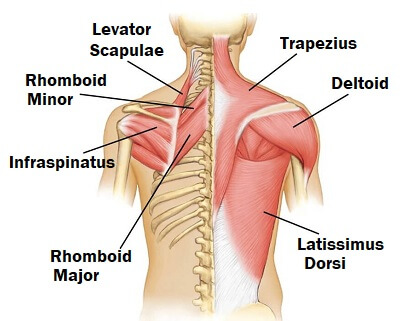
The Shoulder has the sternoclaviculohumeral (SCH) joint and the scapularthoracic joint. I focused on the muscles around the SCH joint last time, which means I-R smart and to be fair it smarted to learn all of that information… basically, I broke up this in a different way than most exercise science people to help you learn how to move your body in the best way.
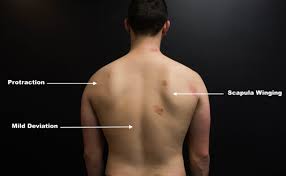
The neck is a mobility joint, the lumbar spine is for mobility, and the SCH joint is for mobility, which means your thoracic spine and scapula is meant for stability. This means if you work out this joint for mobility it will hurt you like causing scapular winging or scapular protraction. For your scapula don’t follow the redbull motto!!! The wings they mean is that it’s made to overcome jet lag, but your scapula need to be strong.
You should have about 10 degree’s of shoulder movement from this joint, and most people think of the exercises needed for this joint as upper back exercises and some as shoulder exercises. Without further ado:
Basic Scapulothoracic exercises:
Elbow wall press – lay angled against a wall and with your elbows bent at 90 degree’s and press your elbows together (this can be done against the floor)
Bent over row – Adjust the angle to adjust between Rhombodius (looks like a rhomboid) (perpendicular), trapezius (lower hands), and latissimus dorsi (raised hands).
Standing bent arm external rotation – hold your arms out towards your side bent at the elbows and raise your wrists up towards the ceiling. (Increase weight or distance by rotating your arms down till your hands point towards the floor)
HIp hinged bent arm internal rotation – same as above, but bend at the hips until your upper body is parallel with the floor and rotate your arms down until your hands are at the same line with your hips.
Behind back lift – start weightless until you build form, but put your hands behind your back in full extension and raise them along your spine until they come as high as you’re able.
This may seem super simple, but I am planning on giving more complex movements and exercises in future posts; however, realize that the position of your hands will change what portions of certain muscles engage with these exercises. Don’t be afraid to mix it up by rotating your hands and repositioning your elbows, but for this if your shoulder clicks you want to adjust the roll and glide of your shoulder. This is best under the care of a physical therapist, but you can feel the roll and glisde with your fingers on your SCH joint. The right movements can be trained by just learning what works best by palpation for you. In general they are uniform, but the best way for you to learn first is on yourself.
 MundyWrites
Leave a comment